Features built for IBD
Flarely isn't a generic food diary. Every feature is designed specifically for people living with Crohn's disease and ulcerative colitis — from AI meal analysis to delayed reaction tracking that no other app offers.
AI Meal Photo Analysis
Take a photo of your meal and Flarely's AI breaks it down instantly. It identifies individual ingredients, flags common IBD triggers like dairy, gluten, high-fat content, and cruciferous vegetables, and shows you the FODMAP levels for each component. No manual entry. No guessing what was in that sauce.
This is Flarely's flagship feature — the one that makes consistent food tracking actually sustainable. Most people abandon food diaries within a week because logging every ingredient is tedious. With AI photo analysis, you snap a picture and move on. The app handles the rest.
The AI detects hidden ingredients that most people miss: inulin in processed foods, sorbitol in "sugar-free" products, garlic and onion powder in seasoning blends. These are the invisible triggers that make IBD feel random — until you can actually see them.
How to identify your food triggers →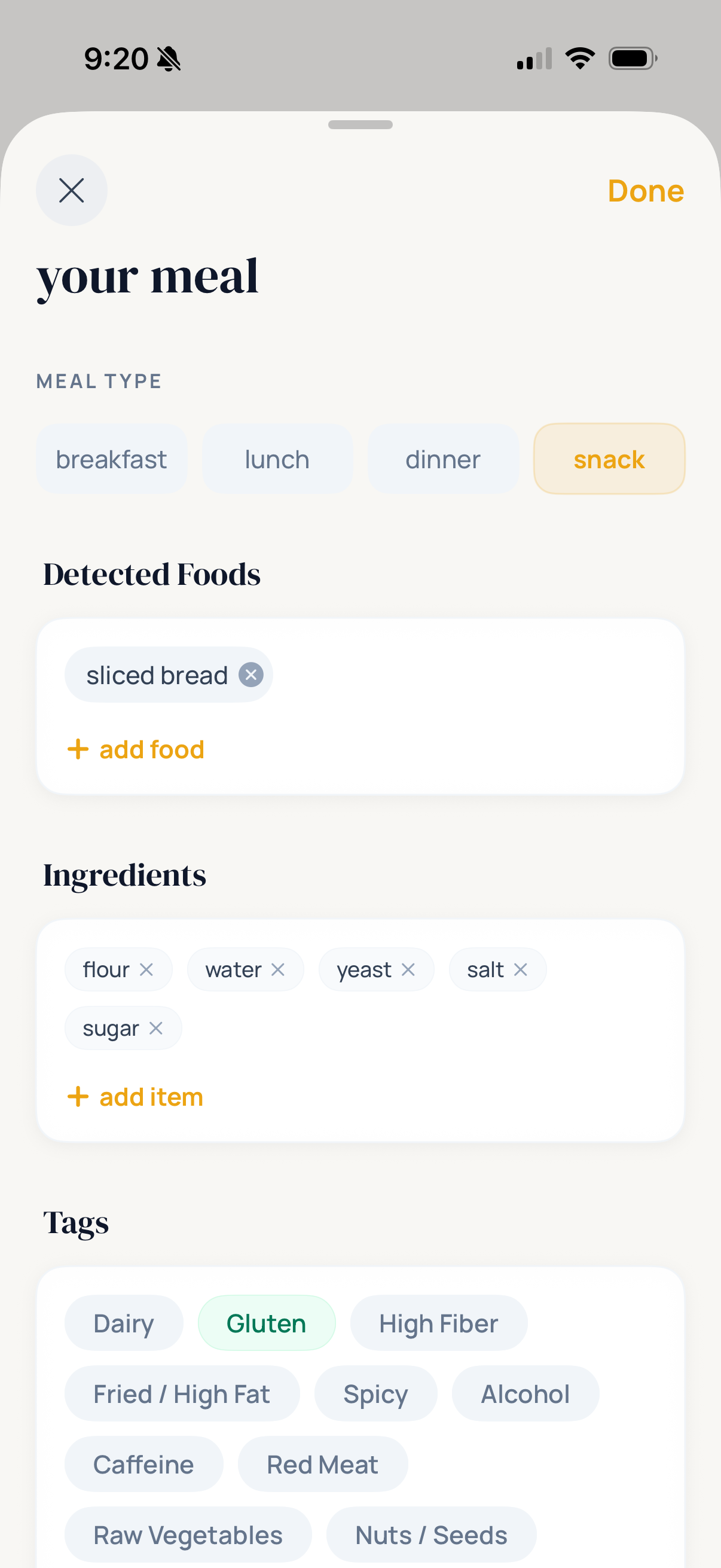
Automatic FODMAP Detection
FODMAPs — fermentable oligosaccharides, disaccharides, monosaccharides, and polyols — are short-chain carbohydrates that many IBD patients struggle to digest. They ferment in the gut and can trigger bloating, gas, cramping, and diarrhea, especially during active inflammation. But tracking FODMAP levels manually is complex and time-consuming.
Flarely flags FODMAP levels automatically every time you log a meal. Each ingredient gets tagged with its FODMAP category and level — high, moderate, or low — so you can see at a glance whether your meal is likely to cause problems. No need to cross-reference Monash University charts or memorize which foods fall into which category.
Over time, Flarely's AI correlates your specific FODMAP intake with your symptoms. Not every FODMAP category affects every patient the same way. You might tolerate fructose fine but react badly to fructans. Flarely helps you find your personal threshold.
FODMAP guide for IBD patients →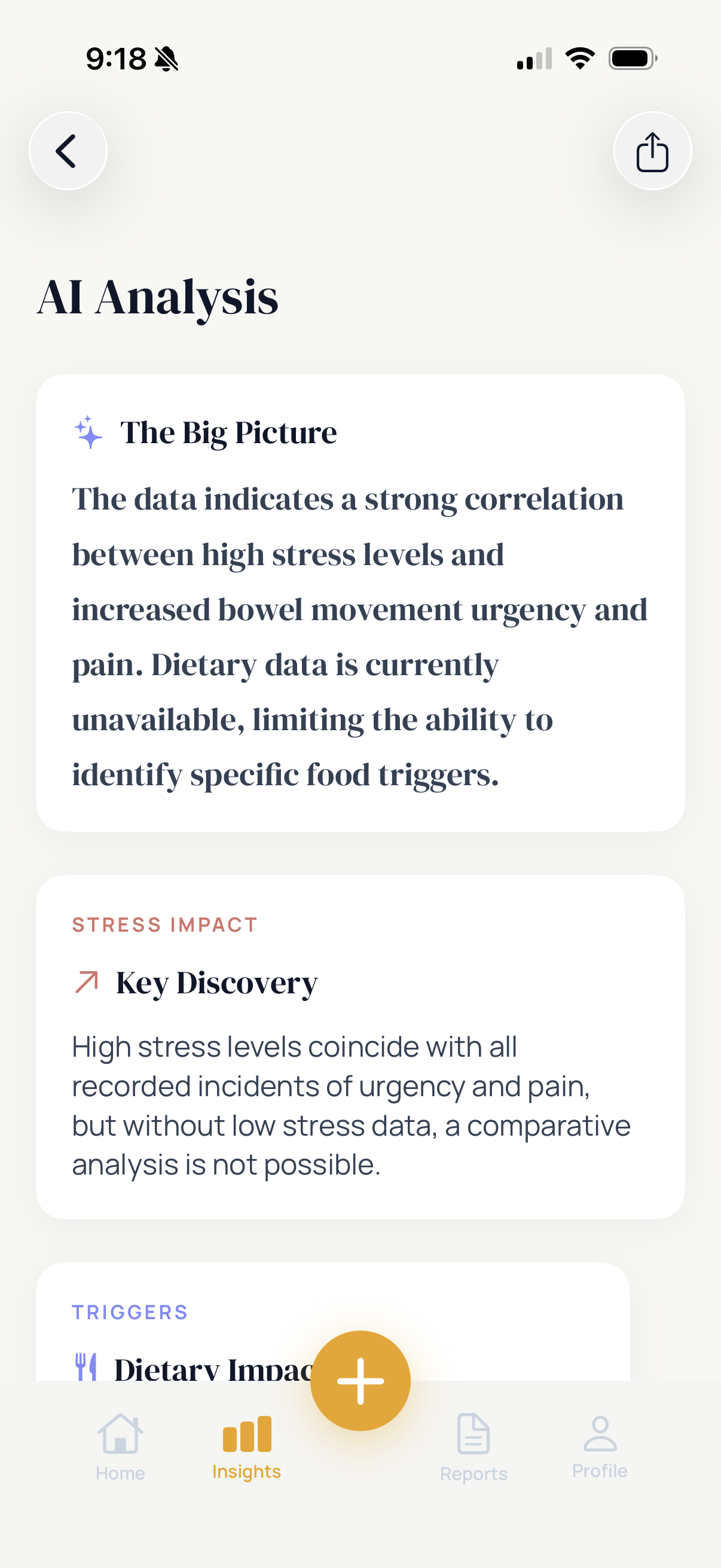
Delayed Reaction Tracking (12-72 Hours)
This is the feature that changes everything — and the reason other food trackers fail for IBD. Food reactions in Crohn's and colitis aren't immediate like a food allergy. That flare you had on Thursday? It might trace back to Tuesday's dinner. The cramping after breakfast might have nothing to do with what you just ate and everything to do with what you had two days ago.
Flarely's AI analyzes your logs across a 12-to-72-hour correlation window. It looks at every meal, every symptom, every bowel movement within that timeframe and finds the connections. This is computationally intensive pattern matching that no spreadsheet, notebook, or generic calorie-counting app can do.
Most food diary apps assume cause and effect happen within the same meal — which is how food allergies work, not how IBD works. Flarely was built from the ground up around the reality of delayed gut reactions, because the founder has UC and lived through the frustration of trackers that couldn't find patterns across days.
Why standard food diaries don't work for IBD → Bowel Movement Logging
Log a bowel movement in under 30 seconds. Select the Bristol stool scale type, urgency level, and whether blood or mucus was present. That's it. Tap, tap, done. Flarely is designed for the reality of IBD — sometimes you're logging from the bathroom and you need it to be fast.
Bristol scale tracking gives your GI doctor standardized data they can actually interpret. Instead of saying "things have been bad lately," you can show them a 30-day trend of stool consistency, frequency per day, urgency episodes, and blood occurrence. That's the difference between a productive appointment and a vague conversation.
Frequency tracking also matters for understanding your baseline. During remission, you might have 2-3 movements a day. When a flare starts, that might jump to 8-10. Catching that trend early — before the pain hits — gives you a head start on managing flares.

Stress & Sleep Correlation
IBD flares aren't just about food. Every gastroenterologist will tell you that stress is one of the most potent flare triggers — and poor sleep compounds it. But most symptom trackers only focus on diet. They miss half the picture.
Flarely tracks stress levels and sleep quality alongside your meals and symptoms. A quick daily check-in — how stressed were you today, how well did you sleep — feeds into the AI's pattern detection engine. It can surface multi-factor correlations you'd never find on your own — like dairy appearing alongside worse symptom days when you've also had high stress and poor sleep.
Understanding your non-food triggers is just as important as knowing which ingredients to avoid. Some patients find that stress management does more for their flare frequency than any dietary change. Flarely gives you the data to see which factors matter most for your body.
The role of stress in IBD flares → 30-Day GI Reports
Your GI appointment is 15 minutes. Maybe 20 if you're lucky. You need to make every minute count. Flarely generates a 30-day report showing your symptom trends, food correlations, bowel movement patterns, and flare frequency — all in a clean format your doctor can scan quickly.
Pull it up on your phone in the waiting room or send it ahead of your appointment. Instead of "I think dairy might be a problem," you can show your gastroenterologist that dairy appeared in 80% of meals that preceded worse symptom days in your data. That's data they can work with — not another vague recollection.
Reports include bowel movement frequency and consistency trends, top correlated foods, stress and sleep patterns, and an overall symptom summary. It's the bridge between your daily tracking and your clinical care.
How to make the most of your GI appointment →
On-Device Privacy
Your health data is some of the most sensitive information you have. Bowel movement logs, symptom patterns, food diaries — this is deeply personal. Flarely processes everything on your iPhone. Your data never leaves your device. There is no cloud sync, no server-side storage, no third-party analytics touching your health information.
This isn't just a nice-to-have. It's non-negotiable for health data. Too many wellness apps monetize user data through advertising partnerships or "anonymized" data sales. Flarely has no ads, no data selling, and no venture capital pressure to monetize your information. You pay for the app. That's the business model. Your data is yours.
On-device processing also means the app works offline. Log your meals in a restaurant with bad wifi. Track symptoms during a flight. Your data is always available because it's always on your phone.

Built specifically for IBD
Flarely isn't a calorie counter repurposed for gut health. Every feature was designed around the specific challenges of living with Crohn's disease and ulcerative colitis — delayed reactions, multi-factor triggers, and the need for data your GI can use.
Your IBD has patterns.
Let Flarely find them.
Free to download. 14-day trial of everything.
Not ready to download yet?
Get IBD tracking tips and product updates — straight to your inbox.
No spam, ever. Unsubscribe anytime.
Flarely is a tracking tool, not medical advice. It does not diagnose, treat, or cure any condition. Always consult your gastroenterologist before making changes to your diet or treatment plan.